Kept, Not Chosen
Breadcrumbing does not end the story. It keeps rewriting the story, just enough to stop you from walking away.


In my Substack article The Silence We Choose, I examined the topic of ghosting: the clean, if brutal, disappearance of people. Someone is there, and then they are not. The silence is devastating, but at least it has the decency to be a complete sentence. You grieve. You process. Eventually, you move on.
Breadcrumbing is a different animal entirely. Breadcrumbing does not leave, it lingers. Someone who breadcrumbs sends a message at 11 p.m. on a Tuesday just to remind you she/he exists, then goes quiet for days or weeks. It is not silence. It is noise carefully calibrated to keep you locked in.
If ghosting is a door slamming shut, breadcrumbing is a door left perpetually ajar. A door never open enough to enter, never closed enough to walk away from. In that gap, people lose months. Sometimes years.
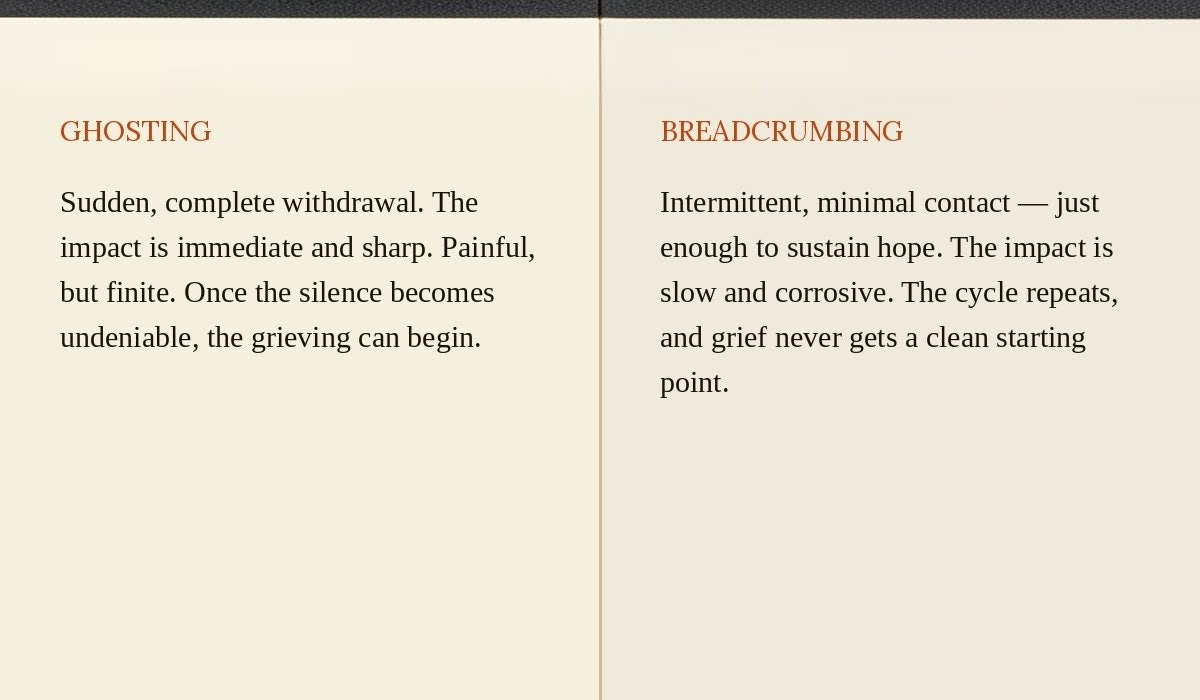
This is what makes breadcrumbing, in some ways, more harmful than ghosting. With ghosting, there is a one-time wound. With breadcrumbing, the wound is periodically reopened just often enough that it never fully heals, and just infrequently enough that you start to wonder if you are being too sensitive for even noticing.
What The Breadcrumber Is Really Doing
I want to resist the easy answer, which is that breadcrumbers are simply selfish. Some are. But the behavior is more psychologically nuanced than that, and understanding it is the first step toward either addressing it or leaving it behind.
At its core, breadcrumbing is a strategy of option preservation. The breadcrumber is unwilling to commit, not necessarily because they do not care about you, but because committing to you means closing a door on something else. That something else might be another person, a version of themselves they have not figured out yet, or the comfort of keeping all options open.
They are not stringing you along out of malice. They are stringing you along out of cowardice. Sometimes, they do not even know the difference.
There is also a validation dimension. Every time you like their message or return their intermittent warmth, they receive confirmation that they are desirable or wanted. You are not a priority. You are a mirror. Mirrors are useful precisely because they reflect without demanding anything in return.
Fear of confrontation plays a role too. Many breadcrumbers know, on some level, that they are not offering what the other person deserves. But ending things cleanly requires a difficult conversation. Difficult conversations carry the risk of conflict, guilt, and the loss of validation they have been quietly feeding on. A well-timed “hey, been thinking about you” is much easier than “I need to be honest about where I stand.”
Breadcrumbing often lives at the intersection of avoidant attachment, low emotional accountability, and the fear of missing out. The crumbs are not generosity. They are a hedge.
What The Breadcrumbed Person Is Really Accepting
Here is the harder conversation, the one that requires us to look inward rather than outward.
Breadcrumbing only works if someone keeps picking up the crumbs. The question I want to examine is: why do people let this happen? The answer is rarely simple, and it is never something to be ashamed of. However, I think the answer is something to think hard about.
Often, it begins with hope. The first disappearance is explained away. The intermittent contact is rationalized; they are busy, they have a complicated life. People are good at building full narratives out of partial evidence. Someone who sends occasional warmth gives us just enough material to work with. The mind, desperate for consistency, fills in the rest.
People do not accept breadcrumbs because they are weak. They accept them because somewhere, they decided that a little is better than nothing. That belief is the thing worth examining.
Beneath that hope, there is often an older wound. People who have been taught by early relationships or experience that they are not worth full attention. They have been told that love is earned through patience, or that needing more is asking too much.
Breadcrumbing fits a familiar template. It feels like love because it replicates the anxious hope of waiting for something that never quite arrives.
There is also the sunk cost effect. You have invested time, emotion, and optimism into this person. Accepting that the return on investment is breadcrumbs and not a relationship means acknowledging that the investment may have been misplaced. That is a loss no one is eager to sit with. So people keep going.
None of this is weakness. All of it is human. But the moment you can name the hope, wounds, and sunk cost is the moment breadcrumbing loses a little of its grip.
How Both Sides Break The Cycle

The elephant in the room is that breadcrumbing is a two-person dynamic. It continues because one person keeps leaving crumbs and another keeps following the trail. Both sides have work to do.
For the breadcrumber: The starting point is true honesty. Honesty not with the other person first, but with yourself. Ask the question you have been avoiding: Am I willing to show up for this person the way they deserve, or am I keeping them around because it benefits me? If the answer is the latter, the kindest thing you can do is say so. Not with a “let’s keep it casual” that you know they will interpret as hope.
Say it with a direct, clear, and respectful conversation. You will lose the validation. You will feel the discomfort of that conversation. However, you will stop being the kind of person who takes from others but is not willing to give back. That is worth something.
Confronting your own avoidance is not comfortable. But integrity is built in these moments when you choose honesty over convenience, even when no one is forcing you to.
For the person being breadcrumbed: The work is in retraining what you accept as enough. This begins with observation rather than confrontation. Track the pattern, not just the moments. Does this person show up consistently, or only when the silence becomes long enough to be noticed? Is this situation progressing, or cycling? Once you see the pattern clearly, you can name it first to yourself and to the other person.
Setting a standard does not mean issuing an ultimatum. I believe it means clearly stating what you need and allowing the other person’s response to tell you everything. “I have noticed we tend to connect in bursts and then go quiet for long stretches. I am looking for something more consistent. Where do you see this going?”
Their response, whether in words or in the silence that follows, is your answer.
Sometimes the work is simply in walking away. Not dramatically, but with clarity. The trail of crumbs does not lead anywhere. It is designed not to. You can put them down and choose a different direction.
The Slow Drip And What It Costs
Ghosting leaves a scar. Breadcrumbing leaves something subtler and, in some ways, more insidious: it leaves doubt. Doubt about your own perception, your own worth, your own judgment. You were never abandoned: you were kept. Just not enough. And it is much harder to grieve something that technically never ended.
What breadcrumbing ultimately costs both parties is the same thing: honesty. The breadcrumber avoids it. The breadcrumbed person keeps hoping it will arrive on its own. Neither gets what they actually want, because genuine connection cannot survive on a diet of sporadic texts and half-intentions.
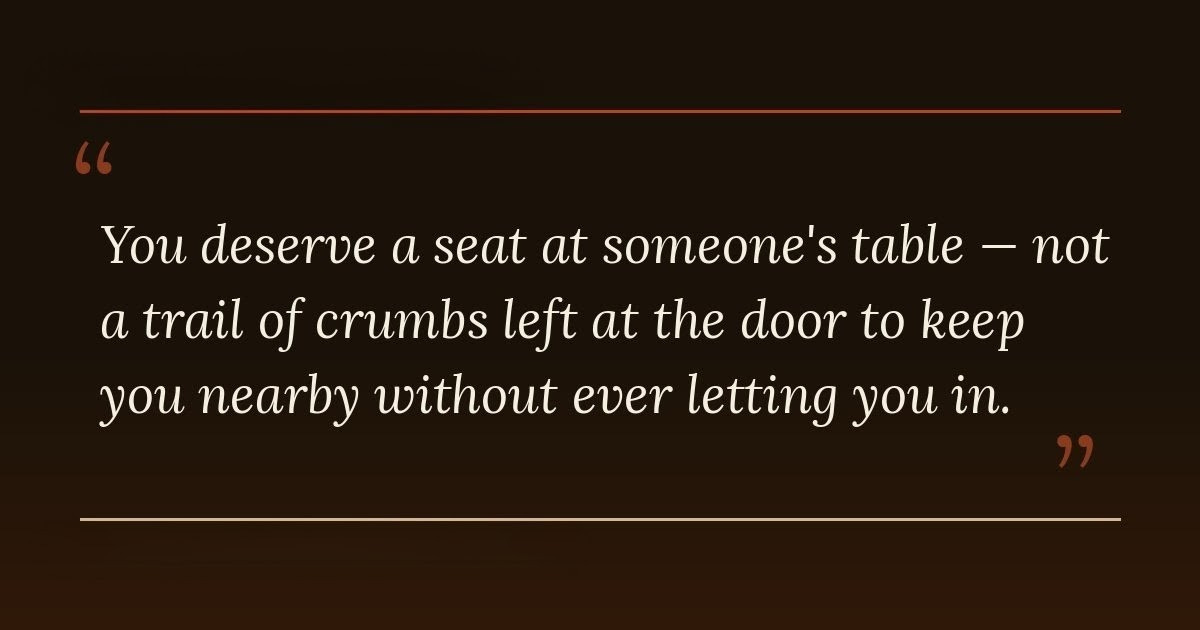
Most of us have, at one point, been on both sides of this dynamic: leaving crumbs when we should have been upfront, or following a trail we knew, deep down, was leading nowhere.
The crumbs will always be there. The question is whether you keep following them.